Anxiety is exhausting in a specific way. Not the tired-and-sleepy kind — the tired-but-wired kind. Your body is in a state of low-level alarm that won’t turn off. Your thoughts loop. Your muscles are tense without reason. Sleep doesn’t fully restore you because your nervous system never fully rests.
Pharmaceutical options exist and work for many people. But a significant portion of people with anxiety — particularly the kind that sits at a constant low hum rather than acute panic — respond well to herbal support. Several herbs have substantial research behind them. They work through different mechanisms, which means the right choice depends on your specific experience of anxiety. Here’s what the evidence actually shows.
How Herbs Work for Anxiety — The Basic Mechanism
Most anxiety-reducing herbs work through one of three pathways. Some modulate GABA — the brain’s primary inhibitory neurotransmitter that creates a calming effect. Others reduce cortisol by acting on the HPA axis (the hypothalamic-pituitary-adrenal stress response system). A third group works on serotonin pathways, which affect mood stability and worry.
Understanding which mechanism a herb uses helps match it to the type of anxiety. High cortisol from chronic stress responds differently than GABA-related tension or serotonin-related worry. Most people benefit from combining one adaptogen (for cortisol) with one GABA-supporting herb rather than taking everything at once.
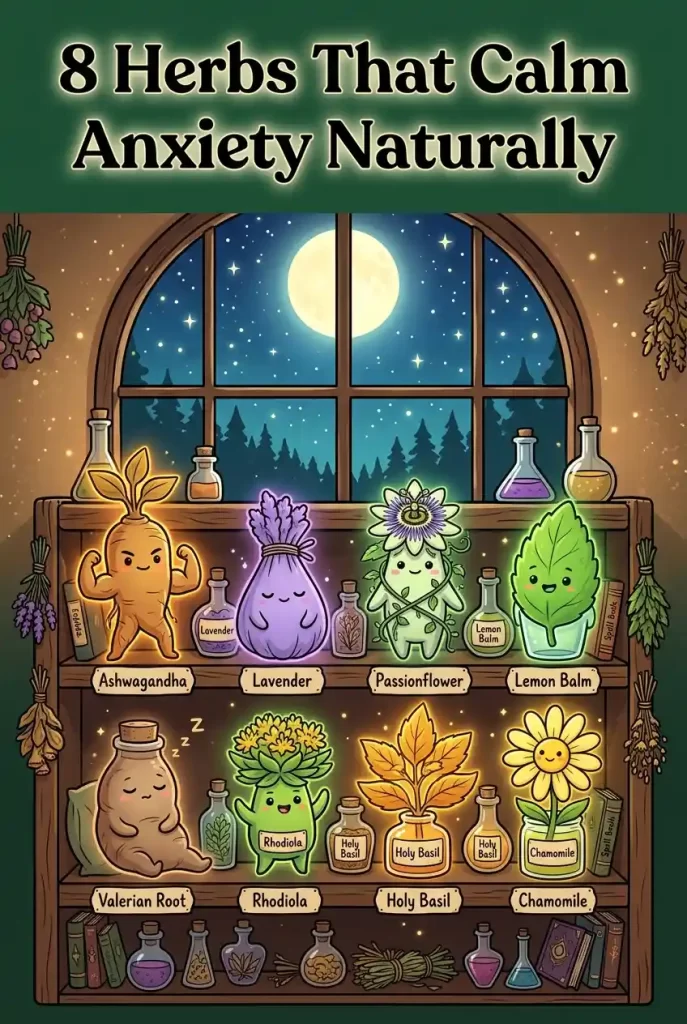
8 Herbs for Anxiety With Real Research Behind Them
1. Ashwagandha — Best for Chronic Stress and Cortisol
Ashwagandha is the most studied adaptogen for anxiety and stress. Multiple randomized controlled trials have found significant reductions in cortisol levels, perceived stress scores, and anxiety symptoms with 300 to 600mg of root extract daily. It works by regulating the HPA axis — essentially teaching the stress response to be less reactive over time. It’s not fast-acting. Results build over 4 to 8 weeks of consistent daily use. Best form: KSM-66 or Sensoril standardized root extract, taken with food to avoid nausea.
2. Lavender — Surprisingly Effective for Generalized Anxiety
Most people think of lavender as a mild sleep aid. The research tells a different story. An oral lavender oil preparation called Silexan has been compared directly to lorazepam (a benzodiazepine) in clinical trials and showed comparable effectiveness for generalized anxiety disorder — without the sedation or dependency risk. It works primarily through calcium channel modulation in the nervous system. Aromatherapy lavender is gentler but still useful — inhaling it for 3 to 5 minutes before stressful situations produces measurable anxiolytic effects.
3. Passionflower — For Fast-Acting Situational Anxiety Relief
Passionflower works on GABA receptors similarly to benzodiazepines, but with much milder effects and no dependency. Studies show it reduces anxiety before medical procedures as effectively as low-dose oxazepam. It’s one of the faster-acting herbs on this list — effects are noticeable within 30 to 60 minutes of taking it as a tea or tincture. Particularly useful for situational anxiety — presentations, flights, social events — rather than chronic background anxiety. Steep 1 teaspoon of dried passionflower in hot water for 10 minutes. One to two cups daily.
4. Lemon Balm — For Anxious Thoughts That Won’t Quiet Down
Lemon balm (Melissa officinalis) inhibits an enzyme called GABA transaminase, which breaks down GABA — meaning it increases GABA availability without directly binding to receptors. The result is a gentle calming effect on racing thoughts and mental restlessness without sedation. It works well during the day for people who need to stay functional. Studies show effects within a single dose at 300 to 600mg. It pairs particularly well with valerian for sleep-related anxiety. As a tea: steep 1 to 2 teaspoons of dried lemon balm for 8 minutes.
5. Valerian Root — For Anxiety That Disrupts Sleep
Valerian is primarily known as a sleep herb, but its anxiolytic mechanism is well-documented. It binds to GABA-A receptors and also acts on serotonin receptors. For people whose anxiety manifests mainly at night — racing thoughts at bedtime, difficulty staying asleep, waking at 3am with worry — valerian addresses both the anxiety and the sleep disruption simultaneously. Take 300 to 600mg of root extract about 1 hour before bed. It takes about 2 weeks of consistent use before the sleep benefits fully establish. Some people experience vivid dreams initially, which typically fades.
6. Rhodiola Rosea — For Anxiety From Burnout and Exhaustion
Rhodiola is an adaptogen that works differently from ashwagandha. Where ashwagandha is better for calming an overactive stress response, rhodiola is better for anxiety that comes from depletion — the kind that shows up after prolonged stress, burnout, or physical exhaustion. It improves stress resilience and mental performance under pressure. Studies show reductions in anxiety, fatigue, and burnout symptoms within 1 to 2 weeks at 200 to 400mg daily. Take it in the morning — it has a mild stimulating quality that can interfere with sleep if taken in the afternoon.
7. Holy Basil (Tulsi) — For Everyday Stress and Anxious Mood
Holy basil is deeply ingrained in Ayurvedic medicine as an adaptogen and stress-reducing herb. It lowers cortisol, reduces anxiety scores in studies, and has anti-inflammatory effects that benefit the gut-brain axis — relevant because gut inflammation and anxiety are closely connected. As a tea it’s one of the most pleasant-tasting herbs on this list — slightly sweet, slightly peppery, aromatic. Two to three cups daily is the traditional and research-supported dose. It’s gentle enough for daily long-term use.
8. Chamomile — The Most Accessible Anti-Anxiety Herb
Chamomile gets underestimated because it’s so familiar. A clinical trial from the University of Pennsylvania found that chamomile extract significantly reduced generalized anxiety disorder symptoms over 8 weeks — this wasn’t a mild effect, it was clinically meaningful. The active compounds apigenin and luteolin bind to GABA receptors and have mild serotonergic effects. A strong cup of chamomile tea — 2 teaspoons of dried flowers steeped for 10 minutes — delivers a meaningful dose. Three cups daily for anxiety support. One cup before bed for sleep.
How to Choose the Right Herb for Your Type of Anxiety
Chronic stress and high cortisol: Ashwagandha (daily) + Holy Basil tea
Racing thoughts and mental restlessness: Lemon Balm + Chamomile tea
Anxiety that disrupts sleep: Valerian + Lemon Balm before bed
Situational or acute anxiety: Passionflower tea 30 to 60 minutes before the event
Burnout-related anxiety and exhaustion: Rhodiola in the morning + Ashwagandha in the evening
Mild everyday anxiety: Chamomile tea throughout the day + Lavender aromatherapy
Important Cautions
Herbal anxiety support is appropriate for mild to moderate anxiety. Severe anxiety, panic disorder, PTSD, and anxiety accompanied by depression often require professional treatment — herbs can be supportive alongside that treatment, not a replacement for it.
- Valerian and passionflower can increase the effects of sedative medications — avoid combining with benzodiazepines or sleeping pills without medical guidance
- Ashwagandha is contraindicated in pregnancy and for people with autoimmune conditions
- Rhodiola can increase blood pressure in some people — check if you have hypertension
- St. John’s Wort (not on this list) interacts with many medications including birth control and antidepressants — research interactions before using any herb alongside medication
- If anxiety is sudden-onset, severe, or accompanied by chest pain or shortness of breath, seek medical attention
The Short Version
Ashwagandha for chronic stress. Passionflower for acute situational anxiety. Lemon balm for racing thoughts during the day. Valerian for nighttime anxiety and sleep. Chamomile as your daily foundation. Start with one, use it consistently for 3 to 4 weeks, and evaluate before adding another. Most people notice a meaningful difference within 2 weeks of consistent use.