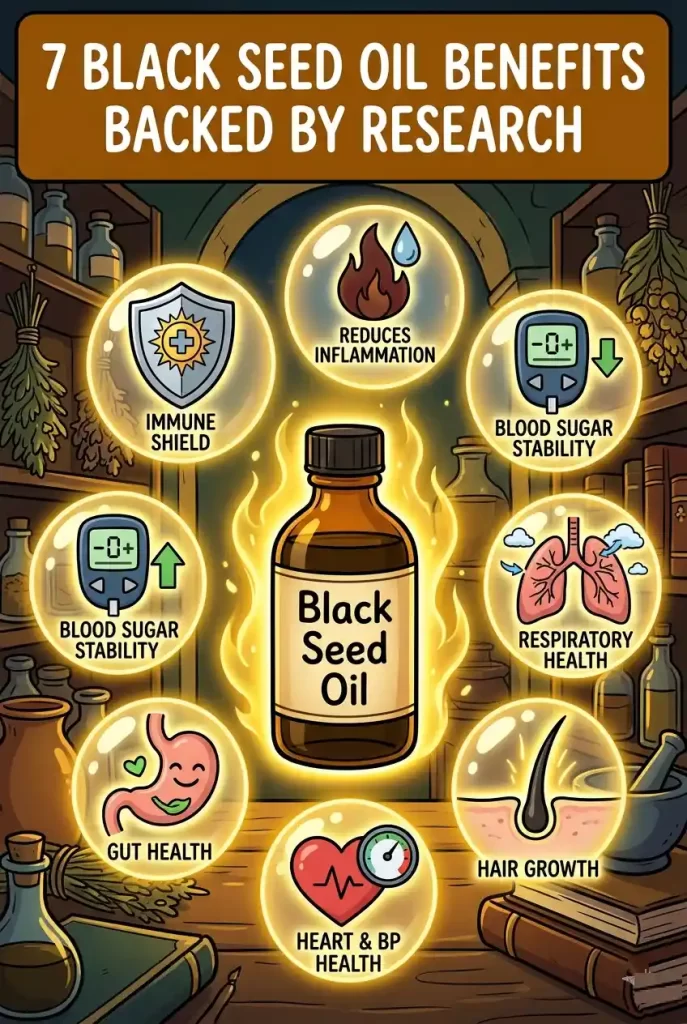
There’s an ancient saying — recorded in Islamic tradition — that black seed is a remedy for everything except death. That’s a bold claim. It’s also the reason this oil has been used continuously for over 2,000 years across the Middle East, North Africa, and South Asia as both food and medicine.
Modern research has started catching up. Over 1,000 peer-reviewed studies have examined Nigella sativa — the plant black seed oil comes from — and the findings are genuinely impressive. But like most natural remedies, the reality is more specific than the hype. Some benefits are well-supported. Others are overstated. Here’s what actually holds up.
What Is Black Seed Oil?
Black seed oil is cold-pressed from the seeds of Nigella sativa, a flowering plant native to Southwest Asia. The seeds have a slightly bitter, peppery flavor — similar to a mix of onion, black pepper, and oregano. The oil itself is dark amber and has a sharp, distinctive smell that some people love and others strongly dislike.
The active compound that drives most of its benefits is thymoquinone (TQ). This is what researchers focus on in studies. TQ has documented antioxidant, anti-inflammatory, antimicrobial, and immune-modulating properties. The concentration of thymoquinone varies by brand and extraction method, which is why quality matters significantly with this supplement.
Black Seed Oil Benefits That Are Actually Supported by Research
Immune System Support
This is the most consistent benefit across studies. Thymoquinone modulates immune response — meaning it helps balance the immune system rather than just stimulating it. This makes it useful both for people who get sick frequently and for those with overactive immune responses like allergies. Regular use of 1 to 2 teaspoons daily showed measurable improvements in immune markers in multiple studies.
Reducing Inflammation
Chronic low-grade inflammation underlies most modern health problems — from joint pain to skin conditions to metabolic issues. Black seed oil inhibits several inflammatory pathways simultaneously, including some that common anti-inflammatory drugs also target. The difference is that it does this without the side effects associated with long-term NSAID use. For people with inflammatory conditions, this is arguably the most practically useful benefit.
Blood Sugar Regulation
Several studies have found that black seed oil improves insulin sensitivity and lowers fasting blood sugar levels. The effect is modest compared to medication but real and consistent. For people managing prediabetes or blood sugar fluctuations naturally, adding 1 teaspoon of black seed oil daily alongside dietary changes is worth considering. It works better as a supportive measure than a primary treatment.
Respiratory Health and Allergies
Black seed oil has a long traditional use for asthma and respiratory issues — and the research backs this up better than most people expect. Studies show it reduces bronchial hypersensitivity and improves lung function in people with mild to moderate asthma. For seasonal allergies, it reduces the severity of symptoms including nasal congestion, sneezing, and itchy eyes. This one takes about 4 to 6 weeks of daily use to show noticeable effect.
Gut Health and Digestion
Black seed oil has antimicrobial properties that specifically target harmful gut bacteria without significantly disrupting beneficial flora — a balance that’s hard to achieve with conventional antibiotics. It’s been studied for H. pylori infections with promising results. It also reduces bloating and gas and supports overall gut motility. Take it with food to minimize the chance of nausea, which some people experience when taking it on an empty stomach.
Skin and Hair Benefits
Applied topically, black seed oil reduces inflammation in conditions like eczema, psoriasis, and acne. Its antimicrobial properties help with scalp conditions and its fatty acid content supports skin barrier function. For hair, massaging diluted black seed oil into the scalp 2 to 3 times weekly has shown results for hair thinning related to inflammation. It doesn’t work as a standalone treatment for pattern baldness but is genuinely useful as a scalp health treatment.
Blood Pressure and Cholesterol
Multiple studies found reductions in both systolic and diastolic blood pressure with regular black seed oil use over 8 weeks. LDL cholesterol also decreased in several trials. The effect size is meaningful enough to be clinically relevant but not dramatic enough to replace medication in people with significantly elevated levels. Think of it as a useful addition to lifestyle changes, not a replacement for medical treatment.
How to Take Black Seed Oil — Dose and Method
The dose that appears most consistently in studies is 1 to 2 teaspoons per day. Start with half a teaspoon to assess tolerance, then work up over 1 to 2 weeks. The taste is strong and not everyone tolerates it straight.
Ways to take it:
- Straight off the spoon — fastest absorption, strongest taste
- Mixed into honey — the classic combination used for centuries, honey softens the bitterness significantly
- Added to warm water with lemon — works well as a morning drink
- Mixed into smoothies or salad dressing — least noticeable taste
- Capsule form — convenient but often lower quality and slower acting than the oil itself
Take it with food if your stomach is sensitive. Morning is fine. Evening is fine. Consistency matters more than timing — daily use over 4 to 8 weeks is where results appear. Taking it occasionally does very little.
How to Choose a Quality Black Seed Oil
This matters more than with most supplements. Look for:
- Cold-pressed, unrefined — heat processing degrades thymoquinone
- Stored in dark glass — light degrades the active compounds
- Ethiopian or Egyptian origin — these sources consistently show higher thymoquinone content
- No added ingredients — pure oil only
- Strong smell — if it barely smells like anything, the active compounds have likely degraded
Cheap black seed oil from a bulk retailer is often not worth taking. The thymoquinone content is too low to produce the benefits shown in research. This is one supplement where paying for quality makes an actual difference in results.
Who Should Be Cautious
Black seed oil is generally safe for most adults at normal doses. However, it can slow blood clotting, so people taking blood thinners should check with their doctor before starting. It can also lower blood pressure and blood sugar, which means people already on medication for either of these need to monitor carefully. Avoid therapeutic doses during pregnancy — small culinary amounts in food are fine, but daily teaspoon doses are not recommended.
The Short Version
Black seed oil is one of the more research-backed natural supplements available. Take 1 teaspoon daily with honey or warm water, use cold-pressed oil in dark glass from a quality source, and give it at least 6 weeks before evaluating results. The immune, inflammatory, and respiratory benefits are the strongest and most consistent. Everything else is a useful bonus.