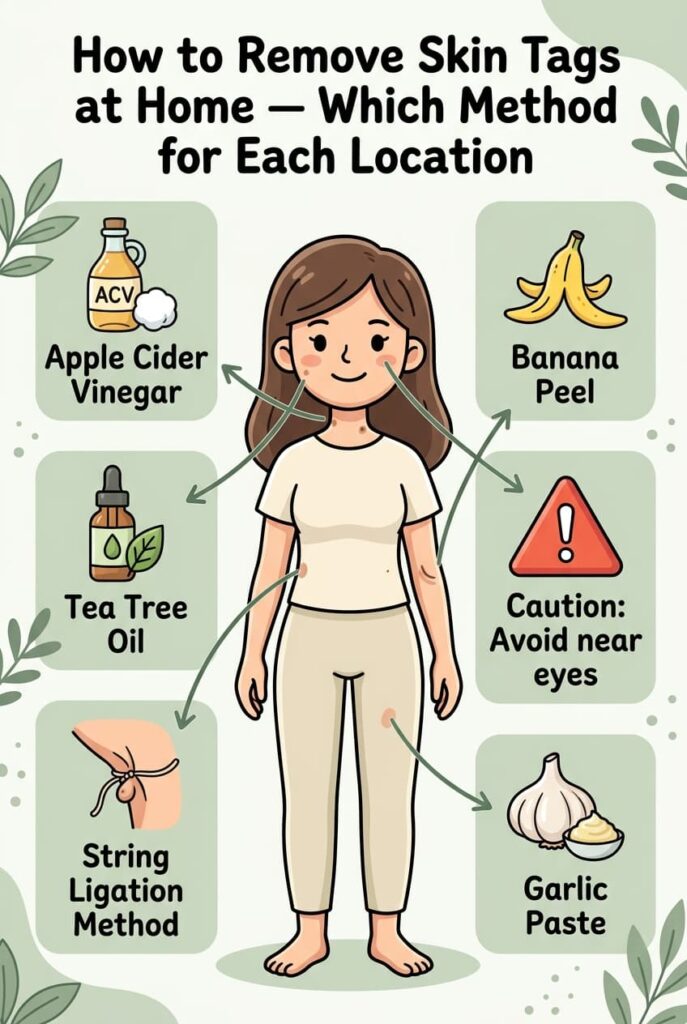
Skin tags are harmless — but they’re annoying, especially when they appear on the neck, face, or underarms where they catch on clothing or jewelry. A dermatologist can remove them in seconds, but that visit costs money most people would rather not spend on something benign.
Several at-home methods are genuinely effective. Some take a few days. Some take a few weeks. The right choice depends on where the skin tag is located, how large it is, and your pain tolerance. Here’s what works, what doesn’t, and the important safety rules.
What Are Skin Tags and Why Do They Form?
Skin tags (acrochordons) are small soft growths made of collagen fibers and blood vessels surrounded by skin. They form most commonly in areas of friction — neck, armpits, under the breasts, groin folds, and eyelids. They’re more common with weight gain, pregnancy, and insulin resistance. They’re completely benign and have no malignant potential. If a growth is hard, irregularly shaped, changes color, or bleeds spontaneously — that needs a dermatologist, not a home remedy.
6 Natural Ways to Remove Skin Tags at Home
1. Apple Cider Vinegar — Most Consistent Results
ACV’s acetic acid gradually breaks down the tissue of the skin tag, causing it to dry out and fall off. Soak a small cotton ball in raw ACV. Apply directly to the skin tag and secure with a bandage. Leave for 15 to 30 minutes. Remove, rinse, and repeat twice daily. Most small skin tags darken, harden, and fall off within 1 to 3 weeks. Protect the surrounding skin with petroleum jelly before each application — ACV can irritate healthy skin with repeated exposure. Do not use on eyelids or around the eye area.
2. Tea Tree Oil — Best for Face and Sensitive Areas
Tea tree oil dries out skin tags through its astringent properties without the acidity risk of ACV. This makes it the better choice for skin tags on the face and neck where skin is more sensitive. Dilute 3 drops of tea tree oil in 1 teaspoon of coconut or jojoba oil. Apply with a cotton swab to the skin tag only. Cover with a small bandage. Repeat 2 to 3 times daily. Results take 2 to 4 weeks — slower than ACV but gentler for delicate areas. Do not use near the eye area or on eyelids.
3. The String Method (Ligation) — Fastest Physical Method
Tying off a skin tag with dental floss or a thin thread cuts off its blood supply, causing it to die and fall off within 3 to 10 days. This is the method dermatologists use with specialized tools — the home version works on the same principle. Clean the area with antiseptic. Tie dental floss or thin thread tightly at the very base of the skin tag, as close to the skin as possible. Tighten each day as it loosens. The skin tag will turn dark, harden, and detach. Clean the area with antiseptic after removal. Best for larger skin tags on the neck or underarms. Not suitable for face, eyelids, or areas around eyes.
4. Banana Peel — Gentlest Option
The inside of a banana peel contains enzymes and tannins that gradually break down skin tag tissue. Cut a small piece of fresh banana peel. Place the inner side directly on the skin tag and secure with a bandage overnight. Remove in the morning. Repeat nightly. Results are slow — 3 to 5 weeks — but there is zero irritation risk, making this the best option for people with very sensitive skin or for skin tags in skin folds. Also works for warts using the same method.
5. Castor Oil and Baking Soda Paste
This combination has a long track record as a home skin tag remedy. Mix a small amount of baking soda with enough castor oil to form a thick paste. Apply to the skin tag, cover with a bandage, and leave overnight. Rinse in the morning. Repeat nightly. The baking soda’s alkalinity and castor oil’s ricinoleic acid work together to dry out and dissolve the skin tag tissue. Results in 2 to 4 weeks for most small to medium skin tags.
6. Iodine Solution
Liquid iodine applied directly to a skin tag breaks down the skin cells gradually. Apply a drop of 2% iodine solution to the skin tag using a cotton swab. Protect surrounding skin with petroleum jelly first. Cover with a bandage. Apply once or twice daily. Results within 2 to 4 weeks. This method works faster than tea tree oil but requires more careful application to protect surrounding skin. Available at most pharmacies. Not for use near eyes.
Which Method by Location
Neck and underarms: ACV or string method — fastest results
Face and cheeks: Tea tree oil — safest for sensitive facial skin
Around eyes (not on eyelids): Tea tree oil very diluted or banana peel only
Eyelids: See a dermatologist — too risky for any home method
Skin folds: Banana peel or castor oil paste — least irritating
Warts (same approach): Banana peel or ACV — both effective for warts too
When to See a Doctor Instead
- The growth is hard, rough, or has an irregular border
- It bleeds without being touched or injured
- It changes color, grows rapidly, or looks different from other skin tags
- It’s on the eyelid — home methods are too close to the eye
- You’re not certain it’s a skin tag — when in doubt, get it checked
The Short Version
ACV twice daily for neck and underarm skin tags — results in 1 to 3 weeks. Tea tree oil for face — gentler, 2 to 4 weeks. String method for larger tags that need faster removal. Banana peel for sensitive skin and warts. Always protect surrounding skin. Never attempt home removal on eyelids.