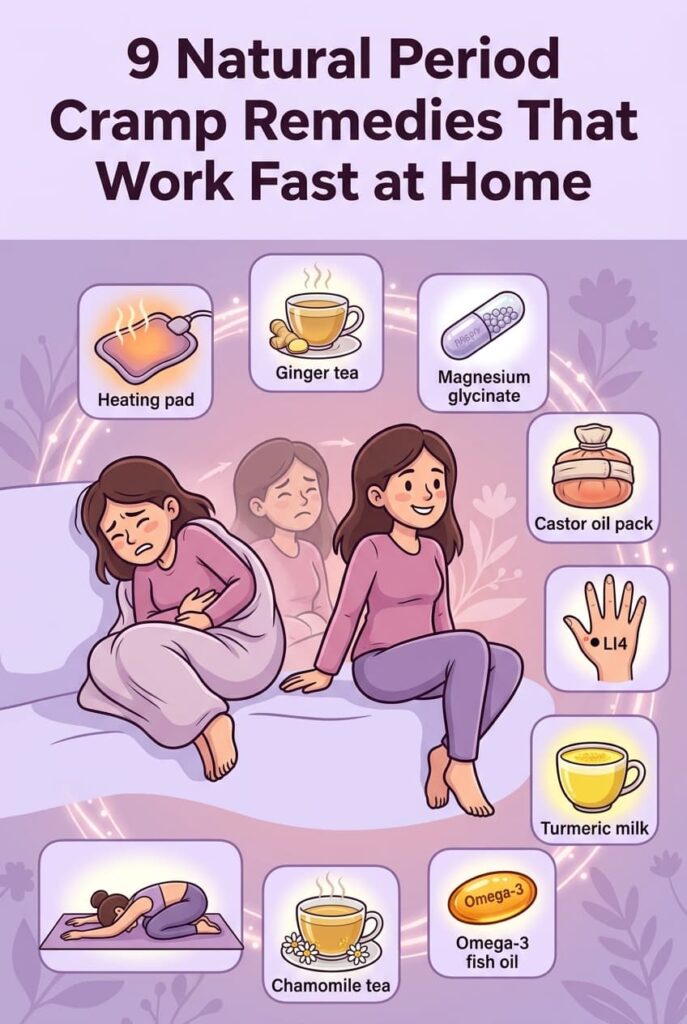
Period cramps range from mildly annoying to completely debilitating. The medical term is dysmenorrhea — and it affects over 80% of women at some point. Most standard advice points to ibuprofen, which works but comes with side effects when taken monthly for years. Natural remedies for period cramps are more effective than most people expect — especially when the right ones are combined.
Thank you for reading this post, don't forget to subscribe!These nine remedies range from immediate relief (heat, pressure points, ginger tea) to methods that reduce cramp severity over time (magnesium, omega-3s, turmeric). Several of them work within 15 to 30 minutes.
Why Period Cramps Happen
Menstrual cramps are caused by prostaglandins — hormone-like compounds that trigger uterine muscle contractions to shed the lining. Higher prostaglandin levels mean more intense contractions and more pain. Conditions like endometriosis, fibroids, and estrogen dominance increase prostaglandin production, which is why some women experience far worse cramps than others. Many natural remedies work by reducing prostaglandin activity or improving uterine blood flow.
9 Natural Period Cramp Remedies
1. Heat Therapy — Fastest Relief
A heating pad or hot water bottle on the lower abdomen is the most immediately effective period cramp remedy — research shows it’s comparable to ibuprofen for pain relief. Heat relaxes uterine smooth muscle and improves local blood circulation, reducing the intensity of contractions. Apply for 20 minutes at a time. For back cramps, apply to the lower back simultaneously. Use as high a temperature as is comfortable without burning — the higher the heat within safe limits, the more effective.
2. Ginger Tea — Anti-Prostaglandin
Ginger directly inhibits prostaglandin synthesis — the same mechanism as ibuprofen, just gentler. A clinical study found ginger as effective as ibuprofen and mefenamic acid for reducing menstrual pain intensity. Simmer a 1 to 2 inch piece of fresh ginger in 2 cups of water for 10 minutes. Add honey and lemon. Drink 2 to 3 cups daily starting 1 to 2 days before your period begins and continuing through the first 2 days.
3. Magnesium Glycinate
Magnesium relaxes smooth muscle — including uterine muscle. Low magnesium is directly associated with more severe menstrual cramping. Taking 300 to 400mg of magnesium glycinate daily, starting 1 week before your expected period and continuing through the first few days, significantly reduces cramp intensity for most women. This is both an acute remedy and a long-term preventive strategy. Results improve with consistent use each cycle.
4. Castor Oil Pack on Lower Abdomen
Applying castor oil to the lower abdomen with a warm compress improves lymphatic circulation and reduces pelvic inflammation. Soak a cloth in warm castor oil, place over the lower abdomen, cover with plastic wrap, apply a heating pad on top. Leave for 45 to 60 minutes. The combination of castor oil’s ricinoleic acid and heat penetrates deeper than heat alone and works particularly well for cramps associated with endometriosis or fibroids.
5. Pressure Point LI4
The pressure point between the thumb and index finger — called LI4 in acupressure — has consistent evidence for reducing menstrual pain. Pinch the fleshy webbing firmly between the opposite thumb and index finger and apply steady pressure for 3 to 5 minutes per side. Results within 5 to 10 minutes for most women. Avoid during pregnancy as LI4 can stimulate uterine contractions.
6. Turmeric and Black Pepper
Curcumin in turmeric inhibits prostaglandin and COX-2 enzyme activity — similar to anti-inflammatory medications. It works best taken preventively starting 3 to 5 days before the period. Take 500mg of curcumin with black pepper (which increases absorption by 2000%) twice daily during the premenstrual and menstrual phase. Can also be taken as golden milk: warm milk, 1 teaspoon turmeric, black pepper, honey.
7. Omega-3 Fatty Acids
Omega-3s reduce the production of series-2 prostaglandins — the inflammatory type responsible for cramping — and increase the production of series-3 prostaglandins which are anti-inflammatory. Women who supplement with omega-3s consistently report significantly reduced cramp intensity. Take 1 to 2 grams of EPA and DHA daily for at least 2 to 3 cycles before evaluating effect. This is a preventive strategy, not an acute fix.
8. Chamomile Tea
Chamomile contains glycine, which relaxes muscle spasms and nerve tension. Studies show it increases urinary levels of glycine — indicating it reaches systemic circulation. Drink 2 to 3 strong cups of chamomile tea (steeped 10 minutes minimum) per day during cramping. It works both for the uterine cramp itself and the associated back and thigh ache. Combines well with ginger tea.
9. Child’s Pose and Knees-to-Chest
Specific yoga positions release tension in the pelvic floor and improve circulation to the uterus. Child’s pose (kneel, lower forehead to floor, arms extended forward) held for 2 to 3 minutes stretches the lower back and pelvis simultaneously. Knees-to-chest lying on your back, gently rocking side to side, releases the sacrum and reduces uterine pressure. Both positions provide noticeable relief within 5 to 10 minutes and can be repeated as needed.
For Severe (Bad) Period Cramps
If cramps are severe enough to disrupt daily life every cycle, address the underlying cause alongside these remedies. Endometriosis, fibroids, and estrogen dominance all produce more intense cramping through excess prostaglandins. Reducing estrogen dominance through DIM, liver support, and seed cycling reduces the prostaglandin load that causes severe pain. These remedies provide relief in the moment — addressing the root cause reduces severity over 2 to 3 cycles.
The Short Version
Heat on lower abdomen immediately. Ginger tea 2 to 3 cups daily starting before your period. Magnesium glycinate starting a week before. LI4 pressure point for fast relief. Castor oil pack for deeper relief. Chamomile tea alongside ginger. Child’s pose for pelvic release. Use several together for best results — they work through different mechanisms and compound each other.