Most people pick herbal tea based on whatever sounds relaxing at the time. That’s not a bad approach — but it leaves a lot of the actual benefit on the table. Different herbal teas work through completely different mechanisms, which means choosing the right one for your specific concern makes a real difference in what you actually get from it.
Chamomile for sleep is well-known. But chamomile also has clinical evidence for anxiety reduction that most people don’t realize. Spearmint tea has documented effects on hormonal acne and testosterone in women. Nettle is one of the most nutrient-dense drinks you can make. Here’s what nine herbal teas actually do, backed by what the research shows — and when to drink each one for maximum effect.
The Most Important Rule About Herbal Tea Preparation
Most guides skip this entirely. Steeping time and temperature matter more than most people think. Weak herbal tea — a teabag dunked for 2 minutes in slightly warm water — delivers a fraction of the active compounds compared to a properly prepared cup. For most medicinal herbs: steep for 8 to 15 minutes in water that has just boiled. Cover the cup while steeping to prevent volatile compounds from escaping with the steam. Loose-leaf tea generally delivers more active compounds than tea bags, which often contain lower-quality dust and fannings.
9 Herbal Teas and What They Actually Do
1. Chamomile — Sleep, Anxiety, and Digestion
Chamomile is the most researched herbal tea for anxiety and sleep. A clinical trial from the University of Pennsylvania found significant reductions in generalized anxiety disorder symptoms over 8 weeks. The active compounds apigenin and luteolin bind to GABA receptors and have mild serotonergic effects. For sleep: 2 teaspoons of dried chamomile flowers steeped for 10 to 12 minutes, drunk 30 to 45 minutes before bed. For anxiety: 3 cups throughout the day. For digestion: one cup after meals — it relaxes the smooth muscle of the intestines and reduces cramping.
Skin benefit: chamomile’s anti-inflammatory compounds reduce redness and irritation when applied topically — cooled chamomile tea used as a face rinse is one of the simplest natural treatments for rosacea-prone skin.
2. Peppermint — Digestion, Headaches, and Energy
Peppermint tea works primarily through menthol, which relaxes smooth muscle, relieves intestinal spasm, and reduces bloating and gas. Multiple studies confirm its effectiveness for IBS symptoms. For headaches: inhaling peppermint tea steam while drinking it targets tension headaches through the same menthol mechanism that makes topical peppermint effective. For energy: peppermint has a mild stimulating effect without caffeine — useful in the afternoon when coffee would disrupt sleep.
Best time to drink: after meals for digestion, mid-afternoon for energy. Steep 1 to 2 teaspoons dried peppermint for 8 minutes. One important note: peppermint can worsen acid reflux in people with GERD by relaxing the lower esophageal sphincter.
3. Spearmint — Hormonal Acne and Testosterone in Women
Spearmint tea has specific anti-androgenic properties — it reduces testosterone levels in women. Two clinical trials showed significant reductions in free testosterone and improvements in hormonal acne with just 2 cups of spearmint tea per day over 30 days. This makes it one of the most targeted natural interventions for PCOS-related symptoms including acne, excess facial hair, and hormonal imbalance.
Best time to drink: morning and afternoon, not before bed (mild stimulating effect). Steep 1 teaspoon dried spearmint for 5 to 7 minutes. Results appear within 3 to 4 weeks of consistent daily use. This is one of the most overlooked herbal tea benefits for women specifically.
4. Ginger — Nausea, Inflammation, and Circulation
Fresh ginger tea is one of the most potent anti-inflammatory drinks available. Gingerols and shogaols inhibit the same inflammatory pathways as NSAIDs without the gastrointestinal side effects. It’s one of the best-studied natural remedies for nausea — morning sickness, motion sickness, and post-chemotherapy nausea all respond well. For circulation: ginger improves blood flow throughout the body, which is why it reduces menstrual cramps (improved uterine circulation) and supports recovery from exercise.
How to make fresh ginger tea: simmer a 1 to 2 inch piece of fresh ginger (sliced) in 2 cups of water for 10 minutes. Add honey and lemon. Far more potent than ginger powder or tea bags.
5. Nettle — Nutrient Density and Allergy Relief
Stinging nettle tea is one of the most nutritionally dense drinks in the herbal world — high in iron, calcium, magnesium, vitamins A, C, and K. It’s particularly valuable for women with heavy periods (replenishes iron), for bone health, and for anyone eating a plant-focused diet. Its anti-histamine and anti-inflammatory properties make it a documented natural remedy for seasonal allergies — start drinking it 4 to 6 weeks before allergy season begins for preventive effect.
Best time to drink: morning or afternoon. Steep 1 to 2 teaspoons dried nettle leaf for 10 to 15 minutes. The longer steep time extracts more minerals. Tastes mild and slightly green — easier than most medicinal teas.
6. Lemon Balm — Stress, Focus, and Cold Sores
Lemon balm (Melissa officinalis) inhibits an enzyme that breaks down GABA, increasing calm and reducing mental restlessness without sedation. It improves mood and cognitive performance simultaneously — unusual for a calming herb. Studies show it reduces anxiety and improves focus within a single dose at 300 to 600mg extract equivalent. As a tea, steep 1 to 2 teaspoons of dried lemon balm for 8 minutes — pleasant lemon scent, mild taste. Also has documented antiviral activity against the herpes simplex virus, making it useful topically and internally for cold sore management.
Best time to drink: daytime, when you need calm focus. Combines well with peppermint.
7. Hibiscus — Blood Pressure and Skin
Hibiscus tea has the most convincing evidence of any herbal tea for cardiovascular benefits. Multiple studies show significant reductions in systolic and diastolic blood pressure with 2 to 3 cups of hibiscus tea daily — comparable in some trials to low-dose ACE inhibitors. Its deep red color comes from anthocyanins, which are potent antioxidants that also benefit skin health by protecting collagen from oxidative degradation.
For skin: hibiscus contains natural AHAs that provide gentle exfoliation and the anthocyanins support elasticity. Drinking it regularly shows up as improved skin texture over 4 to 6 weeks. Best drunk cold or at room temperature — heat degrades some of the anthocyanin content. Steep 2 teaspoons dried hibiscus flowers for 8 to 10 minutes, then cool.
8. Ashwagandha Tea — Cortisol and Stress Resilience
Ashwagandha as a tea is less common than as a supplement, but the root brewed as a tea delivers the active withanolides in their most bioavailable form. It works on the HPA axis, reducing cortisol over 4 to 8 weeks of consistent use. The taste is earthy and slightly bitter — mixing with warm milk, honey, and a pinch of cardamom (golden milk style) makes it much more palatable and adds the anti-inflammatory benefit of the spices.
Best time to drink: evening, about 1 hour before bed. The cortisol-lowering effect supports better sleep quality and the timing allows the compounds to work during the overnight recovery period. 1 teaspoon of ashwagandha root powder simmered in 1.5 cups of water for 10 minutes.
9. Green Tea — Antioxidants, Metabolism, and Skin
Green tea contains EGCG (epigallocatechin gallate), one of the most studied plant antioxidants. It protects skin from UV-induced damage, inhibits melanin synthesis (useful for dark spots), supports metabolic function, and has documented neuroprotective effects. It contains a small amount of caffeine and L-theanine — the combination produces calm, focused energy without the anxiety spike that coffee sometimes causes.
For skin specifically: green tea applied topically and drunk regularly reduces sebum production in oily skin and calms inflammatory acne. Best steeped at 70 to 80 degrees Celsius (not boiling) for 2 to 3 minutes — boiling water makes it bitter and degrades some active compounds. 2 to 3 cups daily for health benefits.
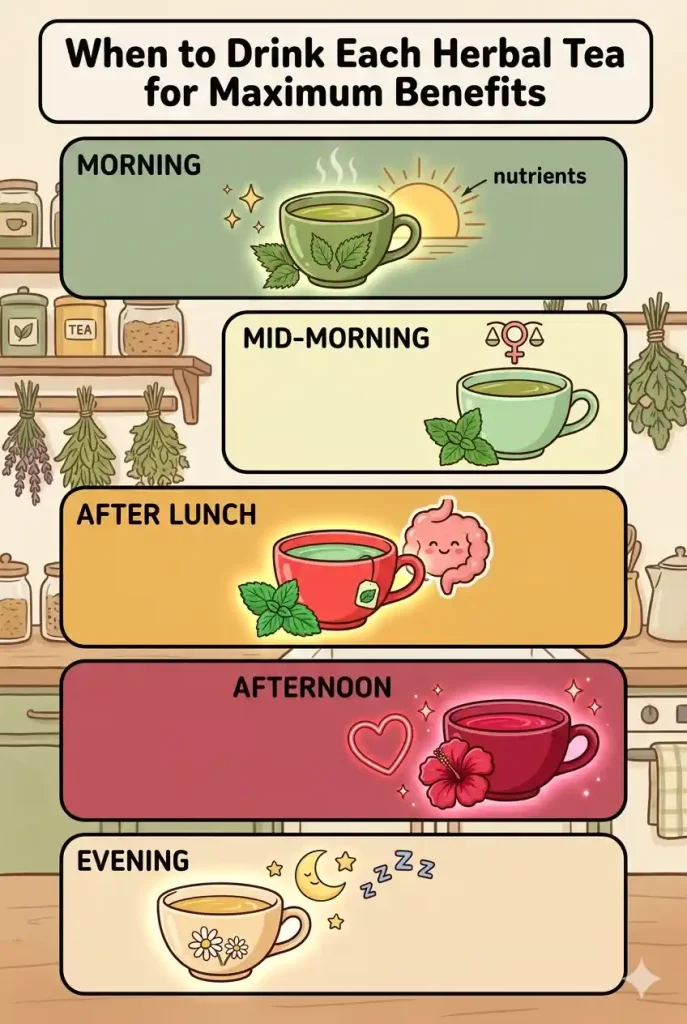
When to Drink Each Tea — Daily Schedule
Morning: Nettle or green tea — nutrients and antioxidants to start the day
Mid-morning: Spearmint if hormonal balance is a goal, lemon balm for calm focus
After lunch: Peppermint or ginger — digestion support after the main meal
Afternoon: Hibiscus (cold) — blood pressure and antioxidants, no caffeine crash
Evening: Chamomile or ashwagandha — wind-down, cortisol reduction, sleep preparation
The Short Version Chamomile for sleep and anxiety. Peppermint after meals for digestion. Spearmint for hormonal acne and PCOS. Ginger for inflammation and nausea. Nettle for nutrients and allergies. Lemon balm for calm focus during the day. Hibiscus for blood pressure and skin. Ashwagandha in the evening for cortisol. Green tea in the morning for antioxidants and focus. Pick two or three that match your current needs and drink them consistently for 3 to 4 weeks before adding more.